Monday, June 6, 2022

Pierre Gilliard's diary entry, dated August 9 (New Style), 1914

Sources:

Treize années à la cour de Russie: Le tragique destin de Nicolas II et de sa famille, page 90, by Pierre Gilliard, 1921


Thirteen Years at the Russian Court, page 110, by Pierre Gilliard, translated by F. Appelby Holt, 1921


The diary entry:

Dimanche 9 août. — ... Jamais ni [l'empereur], ni l'impératrice, n'abordaient avec moi de sujets politiques ou d'ordre intime. Mais les événements prodigieux de ces jours derniers, et le fait que j'ai été de si près mêlé à leurs soucis et à leurs angoisses, m'ont rapproché d'eux et ont fait tomber momentanément les barrières conventionelles de l'étiquette et des usages de cour. ...

English translation (by Holt):

Sunday, August 9th. — ... Neither [the Czar] nor the Czarina ever used to discuss political or personal questions with me. But the amazing events of the last few days, and the fact that I have been so intimately associated with their troubles and anxieties, have drawn me closer to them, and for the time being the conventional barriers of etiquette and Court usage have fallen. ...


Above: Nicholas and Alexandra.


Above: Pierre Gilliard.

Pierre Gilliard's diary entry, dated August 5 (New Style), 1914

Sources:

Treize années à la cour de Russie: Le tragique destin de Nicolas II et de sa famille, pages 88 to 90, by Pierre Gilliard, 1921


Thirteen Years at the Russian Court, pages 108 to 110, by Pierre Gilliard, translated by F. Appelby Holt, 1921


The diary entry:

Mercredi 5 août. — ... Le soir j'ai de nouveau une longue conversation avec l'impératrice qui ne peut pas admettre que je parte pour la Suisse.

— C'est absurde, vous n'y arriverez jamais, tous les chemins sont coupés.

Je lui dis qu'un arrangement est intervenu entre l'ambassade de France et la légation de Suisse et que nous partirons tous ensemble par les Dardanelles.

— Le malheur est que si vous aves quelque chance — fort minime d'ailleurs — d'arriver chez vous, vous n'en avez aucune de revenir ici avant la fin de la guerre. Et comme la Suisse ne se battra pas, vous resterez chez vous à ne rien faire.

En ce moment le Dr Dérévenko entra dans la salle où je me trouve avec Sa Majesté. Il tient à la main les journaux du soir qui annoncent la violation de la neutralité suisse par l'Allemagne.

— Encore! mais c'est fou, c'est insensé, s'écrie l'impératrice. Ils ont complètement perdu la tête.

Et comprenant qu'elle ne peut maintenant me retenir, elle n'insiste plus et se met à me parler avec bonté de mes parents qui vont être pendant si longtemps sans nouvelles de moi.

— Je n'ai moi-même aucune nouvelle de mon frère, ajoute-t-elle. Où est-il? En Belgique, sur le front français? Je tremble à la pensée que l'empereur Guillaume, par vengeance contre moi, ne l'envoie contre la Russie, il est bien capable de cette vilenie! ... Oh! c'est horrible la guerre! Que de maux, que de souffrances, mon Dieu! ... Que deviendra d'Allemagne? Quelle humiliation, quel écrasement! Et tout cela par la faute des Hohenzollern, par suite de leur orgueil fou et de leur ambition insatiable. Qu'ont-ils fait de l'Allemagne de mon enfance? J'ai gardé de mes premières années de si jolis souvenirs de Darmstadt, si poétiques, si bienfaisants et j'y avais de bien bons amis. Mais, lors de mes derniers séjours, l'Allemagne m'est apparue comme un autre pays, comme un pays inconnu et que je ne comprenais plus... Il n'y avait que les vieux avec lesquels je me retrouvais comme autrefois en communion de pensée et de sentiments. La Prusse a fait le malheur de l'Allemagne. On a trompé le peuple allemand, on lui a inculqué des sentiments de haine et de vengeance qui n'étaient pas dans sa nature... La lutte va être terrible, monstrueuse, et l'humanité marche au devant d'effroyables souffrances...

English translation (by Holt):

Wednesday, August 5th. — ... This evening I had another long talk with the Czarina, who will not hear of my leaving for Switzerland.

"It's ridiculous! You will never get there. All communications are interrupted."

I told her that an arrangement had been made between the French Embassy and the Swiss Legation, and that we should all go home together via the Dardanelles.

"The trouble is that, if you have some chance — it's a very small one — of getting home, you will have no chance of getting back here before the end of the war. As Switzerland will not fight, you will be at home doing nothing."

At that moment Dr. Derevenko entered the room. In his hand he held an evening paper announcing the violation of Swiss neutrality by Germany.

"Again! They must be crazy, mad!" cried the Czarina. "They have absolutely lost their heads!"

Realising she could not keep me now, she abandoned her resistance and began to speak kindly of my relations, who will be without news of me for some considerable time.

"I myself have no news of my brother," she added. "Where is he? In Belgium or on the French front? I shiver to think that the Emperor William may avenge himself against me by sending him to the Russian front. He is quite capable of such monstrous behaviour! What a horrible war this is! What evil and suffering it means! ... What will become of Germany? What humiliation, what a downfall is in store for her? And all for the sins of the Hohenzollerns — their idiotic pride and insatiable ambition. Whatever has happened to the Germany of my childhood? I have such happy and poetic memories of my early years in Darmstadt and the good friends I had there. But on my later visits Germany seemed to me a changed country — a country I did not know and had never known. ... I had no community of thought or feeling with anyone except the old friends of days gone by. Prussia has meant Germany's ruin. The German people have been deceived. Feelings of hatred and revenge which are quite foreign to their nature have been instilled into them. It will be a terrible, monstrous struggle, and humanity is about to pass through ghastly sufferings. ..."


Above: Alexandra.


Above: Pierre Gilliard.

Pierre Gilliard's diary entry, dated August 3 (New Style), 1914

Sources:

Treize années à la cour de Russie: Le tragique destin de Nicolas II et de sa famille, pages 87 to 88, by Pierre Gilliard, 1921


Thirteen Years at the Russian Court, pages 106 to 108, by Pierre Gilliard, translated by F. Appelby Holt, 1921


The diary entry:

Lundi 3 août. — L'empereur est venu ce matin chez Alexis Nicolaïévitch; il était transfiguré. La cérémonie d'hier a été l'occasion d'une manifestation grandiose. Lorsqu'il a paru sur le balcon du Palais d'Hiver, la foule immense qui était massée sur la place s'est agenouillée et a entonné l'hymne russe. L'enthousiasme de son peuple a montré au tsar à quel point cette guerre était nationale.

J'apprends que l'empereur a fait hier au Palais d'Hiver le serment solennel de ne pas conclure la paix tant qu'il restera un seul ennemi sur le sol de la Russie. En prenant cet engagement devant le monde entier, Nicolas II marque bien le caractère de cette guerre: c'est la lutte à outrance, la lutte pour l'existence.

L'impératrice s'est entretenue assez longuement avec moi cet après-midi. Elle était dans un violent état d'indignation. Elle venait d'apprendre que, sur l'ordre de Guillaume II, l'impératrice douairière de Russie avait été empêchée de continuer sa route sur Saint-Pétersbourg et avait dû, de Berlin, se rendre à Copenhague.

— Lui, un monarque, arrêter une impératrice! Comment a-t-il pu en arriver là? Il a tout à fait changé depuis que le parti militariste, le parti qui hait la Russie, a pris une influence prépondérante sur lui, mais je suis sûre qu'il a été amené à la guerre contre sa volonté. Il y a été entraîné par le Kronprinz qui s'était mis ouvertement à la tête du parti militariste et pangermaniste, et semblait désapprouver la politique de son père. Il a eu la main forcée par lui.

«Je ne l'ai jamais aimé à cause de son manque de sincérité, il a toujours joué la comédie et il est si vaniteux. Il m'a constamment reproché de ne rien faire pour l'Allemagne et il a mis tout en œuvre pour détacher la Russie de la France, mais je n'ai jamais cru que c'était pour le bien de la Russia. Cette guerre! ... il ne me la pardonnera pas.

«Vous savez que l'empereur a reçu un télégramme de lui avant-hier dans la nuit, plusieurs heures après la déclaration de guerre, et ce télégramme demandait «une réponse immédiate qui seule pouvait encore conjurer l'effroyable malheur». Il a cherché une fois de plus à tromper l'empereur..., à moins que cette dépêche n'ait été retenue à Berlin par ceux qui voulaient à tout prix que la guerre eût lieu.»

English translation (by Holt):

Monday, August 3rd. — The Czar came up to Alexis Nicholaïevitch's room this morning. He was a changed man. Yesterday's ceremony resolved itself into an impressive manifestation. When he appeared on the balcony of the Winter Palace the enormous crowd which had collected on the square fell to their knees and sang the Russian National Anthem. The enthusiasm of his people has shown the Czar that this is unquestionably a national war.

I hear that at the Winter Palace yesterday that the Czar took a solemn oath not to make peace while a single enemy soldier remains on Russian soil. In taking such an oath before the whole world Nicholas II. shows the true character of the war. It is a matter of life and death, a struggle for existence.

The Czarina had a long talk with me this afternoon. She was in a state of great indignation, as she had just heard that on orders from the Emperor William II. the Dowager-Empress of Russia had been prevented from continuing her journey to St. Petersburg and had had to go from Berlin to Copenhagen.

"Fancy a monarch arresting an Empress! How could he descend to that? He has absolutely changed since the militarist party, who hate Russia, have gained the upper hand with him. But I am sure he has been won over to the war against his will. He's been dragged into it by the Crown Prince, who openly assumed the leadership of the pan-German militarists and seemed to disapprove of his father's policy. He has forced his father's hand.

"I have never liked the Emperor William, if only because he is not sincere. He is vain and has always played the comedian. He was always reproaching me with doing nothing for Germany, and has always done his best to separate Russia and France, though I never believed it was for the good of Russia. He will never forgive me this war!

"You know that the Czar received a telegram from him the night before last. It arrived several hours after the declaration of war, and demanded 'an immediate reply, which alone could avert the terrible disaster.' He thus tried to deceive the Czar once more, unless the telegram was kept back at Berlin by those who were bent on war in any case."


Above: Alexandra. Photo courtesy of Ilya Chishko at lastromanovs on VK.


Above: Pierre Gilliard.

Maurice Paléologue's diary entry, dated August 2 (New Style), 1914

Sources:

La Russie des tsars pendant la grande guerre, volume 1, pages 45 to 47, by Maurice Paléologue, 1921


An Ambassador's Memoirs, by Maurice Paléologue, translated by F. A. Holt, 1925


The diary entry:

Dimanche, 2 août 1914.
... Cet après-midi, à trois heures, je me rends au Palais d'hiver d'où, selon les rites, l'empereur doit lancer un manifeste à son peuple. Je suis le seul étranger admis à cette solennité, comme représentant de la puissance alliée.

Le spectacle est majestueux. Dans l'immense galerie de Saint-Georges, qui longe le quai de la Néwa, cinq ou six mille personnes sont réunies. Toute la cour est en costume de gala, tous les officiers de la garnison en tenue de campagne. Au centre de la salle, on a disposé un autel et l'on y a transporté l'icon miraculeuse de la Vierge de Kazan, dont le sanctuaire national de la Perspective Newsky est privé pour quelques heures. En 1812, le feld-maréchal prince Koutousow, partant pour rejoindre l'armée à Smolensk, a longuement prié devant la sainte image.

Dans un silence religieux, le cortège impérial traverse la galerie et se range à la gauche de l'autel. L'empereur me fait inviter à prendre place en face de lui, voulant ainsi, me dit-il, «rendre un public hommage à la fidélité de la France alliée.»

L'office divin commence aussitôt, accompagné par les chants si larges, si pathétiques, de la liturgie orthodoxe. Nicolas II prie avec une contention ardente qui donne à son visage pâle une saisissante expression de mysticité. L'impératrice Alexandra-Féodorowna se tient auprès de lui, le buste raide, la tête haute, les lèvres violacées, le regard fixe, les prunelles vitreuses; par instants, elle ferme les yeux, et sa face livide fait alors penser au masque d'une morte.

Après les dernières oraisons, l'aumônier de la cour lit le manifeste du tsar à son peuple, — simple exposé des événements qui ont rendu la guerre inévitable, appel éloquent à toutes les énergies nationales, imploration du Très-Haut, etc. Puis l'empereur, s'approchant de l'autel, élève la main droite vers l'Évangile, qu'on lui présente. Il est encore plus grave, encore plus recueilli, comme s'il allait communier. D'une voix lente, courte et qui appuie sur chaque mot, il déclare:

— Officiers de ma garde, ici présents, je salue en vous toute mon armée et je la bénis. Solennement, je jure que je ne conclurai pas la paix, tant qu'il y aura un seul ennemi sur le sol de la patrie.

Un fracas de hourras répond à cette déclaration, copiée sur le serment que l'empereur Alexandre Ier prononça en 1812. Pendant près de dix minutes, c'est dans toute la salle un tumulte frénétique, qui se renforce bientôt par les clameurs de la foule massée au long de la Néwa.

Brusquement, avec son impétuosité coutumière, le grand-duc Nicolas, généralissime des armées russes, se jette sur moi et m'embrasse à me broyer. Alors, c'est un redoublement d'enthousiasme, que dominent les cris de: «Vive la France! ... Vive la France! ...»

A travers la cohue qui m'acclame, j'ai grand' peine à me frayer un passage derrière les souverains et à gagner la sortie.

J'arrive enfin à la place du Palais d'hiver, où une multitude innombrable se presse avec des drapeaux, des bannières, des icons, des portraits du tsar.

L'empereur paraît au balcon. Instantément, tout le monde s'agenouille et entonne l'hymne russe. En cette minute, pour ces milliers d'hommes qui sont là prosternés, le tsar est vraiment l'autocrate marqué de Dieu, le chef militaire, politique et religieux de son peuple, le souverain absolu des corps et des âmes.

Tandis que je rentre à l'ambassade, les yeux pleins de cette vision grandiose, je ne puis m'empêcher de songer à la sinistre journée du 22 janvier 1905, où la population ouvrière de Pétersbourg, conduite par le pope Gapone et précédée aussi par les saintes images, s'était massée comme aujourd'hui devant le Palais d'hiver pour implorer «son père, le tsar», et où elle fut impitoyablement mitraillée.

English translation (by Holt):

Sunday, August 2, 1914.
... At three o'clock this afternoon I went to the Winter Palace, where the Tsar was to issue a proclamation to his people, as ancient rites decree. As the representative of the allied power, I was the only foreigner admitted to this ceremony.

It was a majestic spectacle. Five or six thousand people were assembled in the huge St. George's gallery which runs along the Neva quay. The whole court was in full-dress and all the officers of the garrison were in field dress. In the centre of the room an altar was placed and on it was the miraculous ikon of the Virgin of Kazan, brought from the national sanctuary on the Nevsky Prospekt, which had to do without it for a few hours. In 1812, Field-Marshal Prince Kutusov, before leaving to join the army at Smolensk, spent a long time in prayer before this sacred image.

In a tense, religious silence, the imperial cortège crossed the gallery and took up station on the left of the altar.

The Tsar asked me to stand opposite him, as he desired, so he said, "to do public homage in this way to the loyalty of the French ally."

Mass began at once to the accompaniment of the noble and pathetic chants of the orthodox liturgy. Nicholas II prayed with a holy fervour which gave his pale face a movingly mystical expression. The Tsaritsa Alexandra Feodorovna stood by him, gazing fixedly, her chest thrust forward, head high, lips crimson, eyes glassy. Every now and then she closed her eyes, and then her livid face reminded one of a death mask.

After the final prayer the court chaplain read the Tsar's manifesto to his people — a simple recital of the events which have made war inevitable, an eloquent appeal to all the national energies, an invocation to the Most High, and so forth. Then the Tsar went up to the altar and raised his right hand toward the gospel held out to him. He was even more grave and composed, as if he were about to receive the sacrament. In a slow, low voice which dwelt on every word, he made the following declaration:

"Officers of my guard, here present, I greet in you my whole army and give it my blessing. I solemnly swear that I will never make peace so long as one of the enemy is on the soil of the fatherland."

A wild outburst of cheering was the answer to this declaration, which was copied from the oath taken by the Emperor Alexander I in 1812. For nearly ten minutes there was a frantic tumult in the gallery, and it was soon intensified by the cheers of the crowd massed along the Neva.

Suddenly the Grand Duke Nicholas, generalissimo of the Russian armies, hurled himself upon me with his usual impetuosity and embraced me till I was half crushed. At this the cheers redoubled, and above all the din rose shouts of "Vive la France! ... Vive la France! ..."

Through the cheering crowd I had great difficulty in clearing a way behind the sovereigns and reaching the door.

Ultimately I got to [the] Winter Palace Square, where an enormous crowd had congregated with flags, banners, ikons, and portraits of the Tsar.

The Emperor appeared on the balcony. The entire crowd at once knelt and sang the Russian national anthem. To those thousands of men on their knees at that moment, the Tsar was really the autocrat appointed of God, the military, political and religious leader of his people, the absolute master of their bodies and souls.

As I was returning to the embassy, my eyes full of this grandiose spectacle, I could not help thinking of that sinister January 22, 1905, on which the working masses of St. Petersburg, led by the priest Gapon and preceded as now by the sacred images, were assembled as they were assembled to-day before the Winter Palace to plead with "their Father, the Tsar" — and pitilessly shot down.


Above: Alexandra with Nicholas and family in a procession on the day of the declaration of war, on July 20/August 2, 1914.


Above: Nicholas on the balcony of the Winter Palace giving the declaration of war.


Above: Maurice Paléologue.

Monday, May 2, 2022

Pallisander Room

Source:

GMZ Tsarskoe Selo


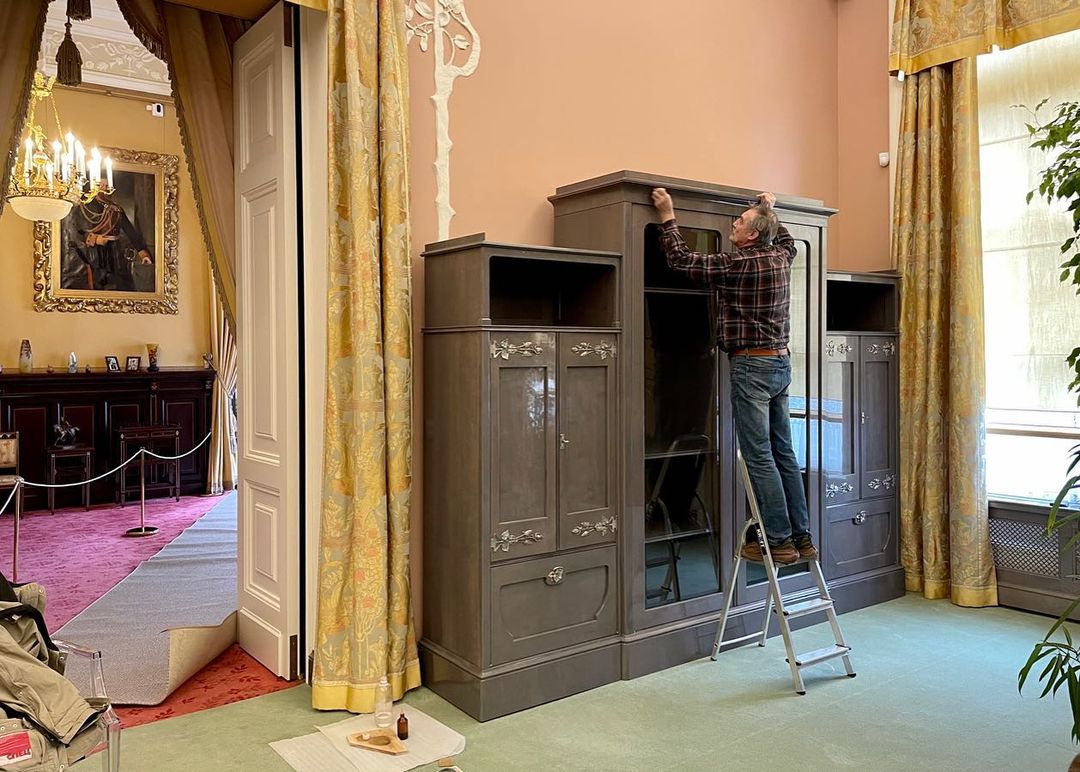
Vitrine cabinet arrives in the Maple Room

Source:

The Tsarskoselskaya Restoration Workshop


Alix's letter to Xenia, dated July 24, 1893

Sources:

Alexandra Feodorovna: Diaries and Correspondence, volume 1: Princess of Hesse, 1872-1893, pages 298 to 299, by George Hawkins, 2023

George Hawkins at Letters and writings of Nicholas II and his family on Facebook


The letter:

Панедѣльникъ July 24th 1893
Darling Xenia,
It is such a century ago that I last heard from my dear little Chicken, that I must send you a few lines to enquire how you are.

Ernie has returned from England, he enjoyed his stay there so much. How did Nicky like it?

I hear Aunt Alix is going to Denmark, are you going to meet them there this year, or do you go in '94? I wish we could meet once again, though I believe I should scarcely recognise you as a grown up lady.

The heat is great, we have been in the garden watching wasp's and hornets' nests being burnt, there are such quantities this year. We play a good deal lawn tennis and I ride generally before breakfast or drive four in hand, wh is such fun.

I wonder what you are doing with yourself, do send me a line some times if it does not bore you too much to write to the old Hen.

With a good tender kiss and love to the others, I remain,
Ever yr very loving old
Alix

I have got again a sweet little squirrel, three tortoises and the parrot. Have you good news from the Weeping Willow? You must excuse this dull letter, but the heat has made me quite ramolie. Do write and tell me what you are all doing. For the present we are stopping here. Jagdschloss, Wolfsgarten, Post Egelsbach, Hessen.

Bless you!


Above: Alix. Photo courtesy of TatianaZ on Flickr.


Above: Xenia.

Notes: Панедѣльникъ (Понедельник) = Monday.

Weeping Willow = Grand Duke Georgy Alexandrovich, Nicholas and Xenia's brother and Alix's future brother-in-law.

ramolie = exhausted, tired.