Some of the sources:
Alexandra's Formal Reception Room was one of the sunniest rooms in the Alexander Palace and the largest of the Imperial Family's personal rooms. It was connected to one of the palace's libraries and was situated in the far right center of the palace. Seven large windows looked out from the room onto the Alexander Park. The walls were covered in white artificial marble and topped with a beautifully moulded entablature whose crispness and clean classical design is the work of the architect Giacomo Quarenghi, who originally built the Alexander Palace in the 1790s. This room preserved that austere late 18th century style commissioned by Empress Catherine the Great, who commissioned the construction of the palace as a gift for her grandson, the future Tsar Alexander I. It is possible that some of the furnishings of this room are part of the original decoration.
The snowy whiteness of the room was offset by heavy, cranberry-coloured curtains on the windows, which had inner drapery made of thin lace. The floor was made of a dark gold parquet. In the center of the room hung a beautiful crystal chandelier with a ruby-red glass center in the Russian style. Ruby-red blown glass is very difficult to make — the red colour is obtained by adding gold to the molten glass before the glassmaker blows it into its delicate shapes. This chandelier was made during the reign of Catherine the Great (who died in 1796) and is most probably original to the room.
The furniture here was some of the finest in the palace, including a roll top desk which contained a musical mechanism, made by famed German cabinetmaker David Roentgen. It dates back to the time when the palace was built and may have been part of Catherine's gift to Alexander and his wife Elizabeth. This table served as Alexandra's formal writing desk and was considered to be one of the most valuable works of art in the palace. After the Revolution it was evacuated to Moscow; and when it returned to St. Petersburg it was taken to the Hermitage, where it stands today. Back in the Formal Reception Room, the staff at the Alexander Palace museum put another desk by Roentgen in its place, one of a matching pair that was found in the palace. These may have been the working desks of Alexander and Elizabeth.
There were also many pieces of antique 18th century French furniture and an enormous Savonierre carpet on the floor. After the French Revolution the French government sold off furniture from the former royal residences. Catherine's representatives went to these auctions and made many purchases. Because these auctions took place at the same time that the Alexander Palace was being built, it is possible that some of this furniture found its way there. Two ivory screens, covered in tapestries, appear to be from the reign of King Louis XV, bearing the French royal monogram.
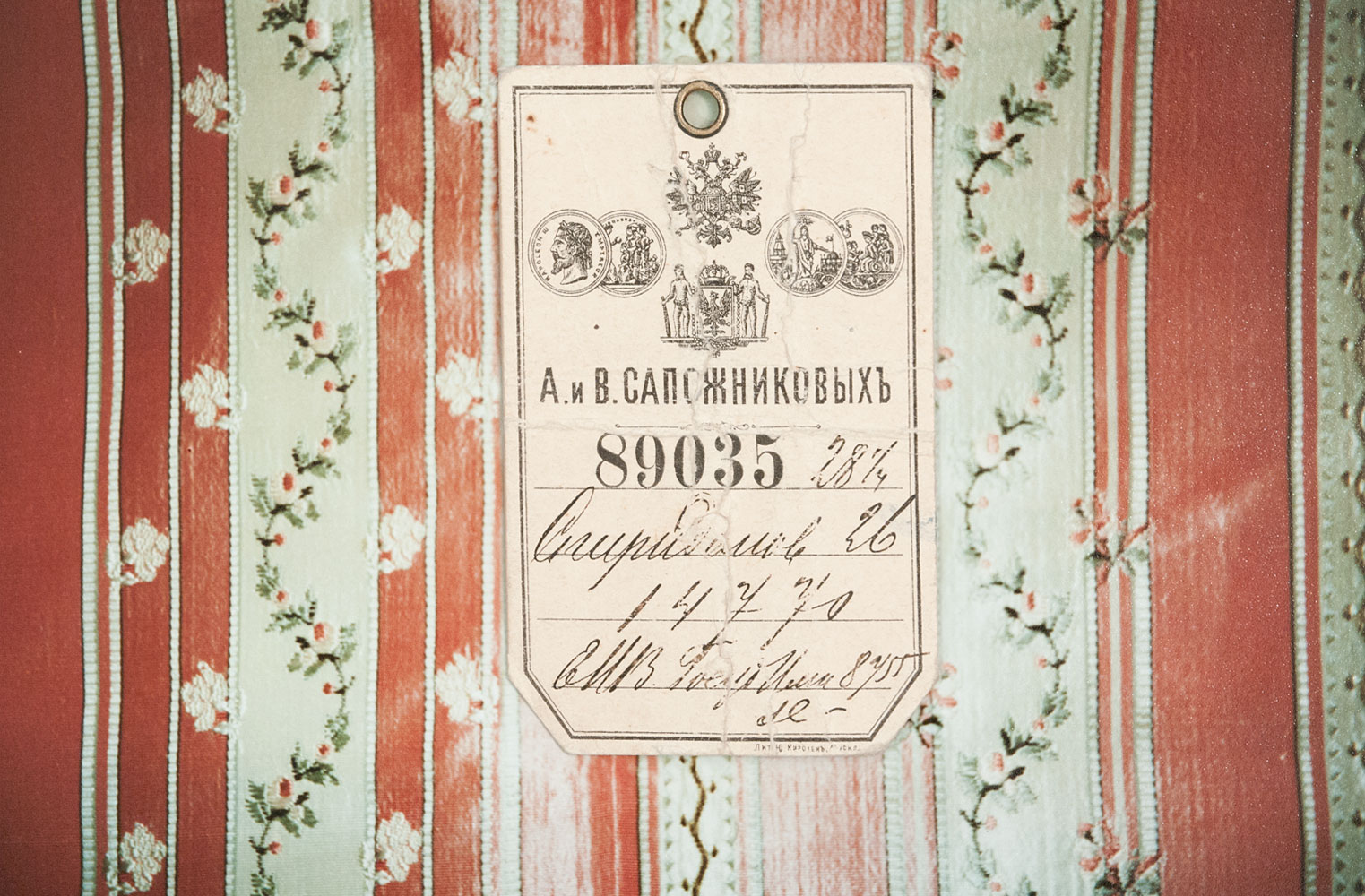
In 1896 Meltzer made some additional pieces of furniture — including an incongruous cozy corner, in the 18th century style, and then upholstered them in a bright red and cream striped fabric with a pattern of flowers and leaves in the stripes. This tied the disparate designs of the furniture together into a suite.
The decorations in the room were a mix of 18th, 19th and early 20th century items. There were a number of small sculptures, including bronze busts of Alexander, Elizabeth and Tsar Paul I. There was also a colourful Wedgewood bust by Enoch Wood of Alexander produced in England in 1814. On the wall hung a splendid marble carving by Marie-Anne Collot of Catherine the Great from 1774 — it was sold by the Soviet government in 1933.
Every hour the Reception Room chimed with the striking of bells from a number of 18th century clocks which stood in different parts of the room.
There were also several large paintings on the walls. The most prominent was a huge painting of The Cossacks of the Imperial Guard, painted by the French military painter Édouard Detaille in 1889 for Tsar Alexander III. Detaille also worked for Nicholas, who had several of his watercolours in his rooms. This giant canvas was commissioned at the cost of $50,000, the equivalent of close to a million dollars today.
Between the two doors in the Formal Reception Room hung a large portrait of Alexandra in a heavy gilt frame which was painted in 1903 by the German painter Kaulbach, who was one of her favourite painters. It is a moody painting showing the Empress in a dark forest wearing a shimmering mauve gown and a diamond tiara. After Kaulbach made studies for Alexandra's face he requested that the dress be sent to Munich, where it was mounted on a mannequin that was the same size as her, allowing the artist to finish the portrait. After the portrait was completed and sent to St. Petersburg, Kaulbach humbly asked the Empress for the dress as a memento, and she granted his request. The Kaulbach family still has the dress in their possession to this day. Kaulbach's study for this portrait was Nicholas's favourite portrait of his wife, and he kept it in his New Study.
One of the most famous items in the Formal Reception Room was a Gobeliens tapestry of Marie Antoinette with her children, a copy after Élisabeth Vigée-Lebrun made in 1887. This tapestry was a gift from the French President Lebrun to Alexandra, who was a collector of Marie Antoinette's personal belongings. The Empress was quite interested in the tragic queen of France and read a lot about her. When she and Nicholas visited France in 1896, Alexandra had been invited by President Lebrun to stay in Marie Antoinette's rooms at the Palace of Versailles. After the Revolution in 1917 this tapestry was used by museum guides as an unlucky talisman foreshadowing Alexandra's fate. While this may seem inappropriate to us today, at the time no one suspected the fate that awaited her, and the gift was never thought to be inappropriate. In 1896 Nicholas and Alexandra's future seemed bright and positive. In the 1990s the museum authorities had a new doorway punched through where the tapestry used to hang.
Next to Detaille's painting was a large painting of The Coronation of Nicholas II, by the Danish court artist Lauritz Tuxen. Copies of this painting hung at the Dowager Empress Marie Feodorovna's Anichkov Palace in St. Petersburg and in Buckingham Palace in London, England.
Alexandra often received ambassadors, ministers and foreign dignitaries in this room. She also received members of the Russian Court and aristocracy here; and the Formal Reception Room was also occasionally used for special dinners or luncheons and could seat 30 people comfortably.
Photos of the room:
Some photos taken in the room:
Paintings in the room (minus Detaille's painting):
Above: The Gobelins tapestry of Marie Antoinette with her children, after a portrait by Élisabeth Vigée-Lebrun.
Above: Portrait of Alexandra by Makovsky after Kaulbach.
The Coronation of Nicholas II, by Lauritz Tuxen.
The autochrome of the room:
The room prior to the 2015-2021 restoration:
Enable GingerCannot connect to Ginger Check your internet connection
or reload the browserDisable in this text fieldRephraseRephrase current sentenceEdit in Ginger